
Updated: Aug 13

Reading time: 4 minutes
Best for: Self-help, patients, families, therapists, teachers, and caregivers
Includes: Printable Visual Guide • Reflection Questions
Diaphragmatic Breathing: Your Body's Calm Button
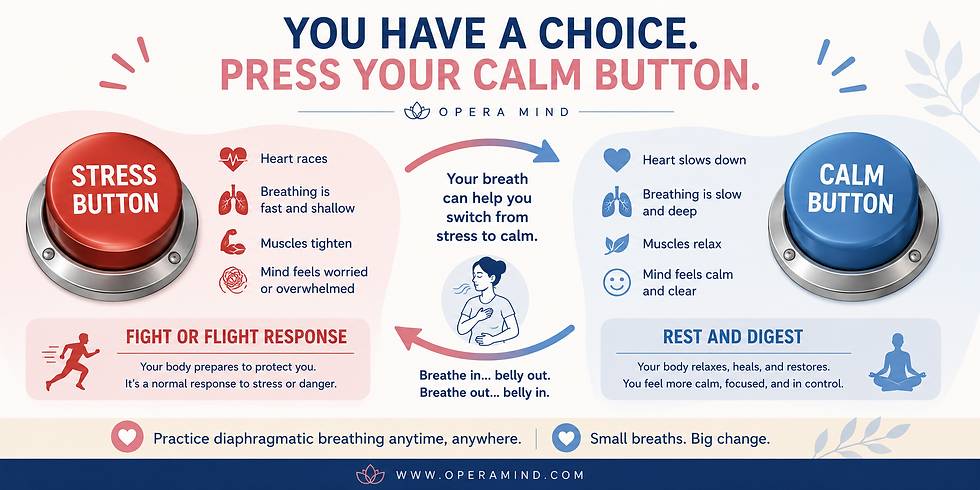
Your Body Has Two Settings
Imagine your body is like a car.
It has a gas pedal and a brake pedal.
When you feel stressed, worried, or frightened, your body steps on the gas.
Your heart beats faster.
Your muscles tighten.
Your breathing gets faster.
Your body is getting ready to protect you.
This is called the fight-or-flight response.
But your body also has a brake.
Slow belly breathing helps press the brake so your body can slow down and relax.
Why Belly Breathing Works
There is a large muscle under your lungs called the diaphragm.
When you breathe deeply into your belly, your diaphragm moves down and your belly gently rises.
This sends a message to your brain:
"I'm safe. I can relax."
Your body begins to:
Slow your heart rate.
Relax your muscles.
Calm your breathing.
Reduce stress and anxiety.
You are not forcing yourself to feel calm.
You are helping your body remember how to calm itself.
Babies Already Know How
Have you ever watched a sleeping baby?

Their little belly goes up...
Then slowly comes back down.
Babies naturally breathe with their diaphragm.
As we get older, stress can change the way we breathe.
Many adults begin taking short breaths from their chest without even realizing it.
The good news is that belly breathing is a skill you can learn again.
How to Practice Belly Breathing
Find a comfortable place to sit or lie down.
Step 1
Place one hand on your chest and one hand on your belly.

Step 2
Breathe in slowly through your nose for 4 seconds.
Let your belly rise like a balloon.
Try to keep your chest as still as possible.
Step 3
Hold your breath gently for 2 seconds.
Step 4
Breathe out slowly through your mouth for 6 seconds.
Feel your belly gently move back in.
Think:
Breathe in... belly out.
Breathe out... belly in.
Step 5
Repeat this 5 to 10 times.
Go slowly.
There is no need to rush.
When Can You Use Belly Breathing?
You can use this simple skill:
Before a test or interview
Before a medical appointment
During a stressful day
When you feel anxious
When you feel angry
When you feel overwhelmed
Before going to sleep
Anytime you need a moment to slow down
The more you practice, the easier it becomes.
A Small Habit That Can Make a Big Difference
You don't need special equipment.
You don't need a quiet room.
You always carry this tool with you.
One slow breath may not change everything.
But several slow breaths can help your body feel safe again.
Small habits can lead to big changes.
Reflection
The Opera Mind Visual Guide below shows each step of diaphragmatic breathing in a simple, easy-to-follow format. Use it to practice at your own pace and come back to it whenever you need a moment of calm.
This Visual Guide is for educational purposes only. It is not a substitute for talking with a licensed mental health professional or receiving medical care.

OperaMind AI Refined — A carefully restored edition that preserves the original educational concepts while enhancing readability, accessibility, and visual design with thoughtful AI assistance.

Opera Mind Classic — The original human-made, hand-crafted version, created before the use of generative AI.
Copyright & Use Policy
All content on this website — including but not limited to infographics, action plans, written materials, and downloadable resources — is the intellectual property of Opera Mind and is protected under U.S. and international copyright laws.
You may not copy, reproduce, modify, upload, publish, transmit, or distribute any material from this site without explicit written permission from the author.
Sharing of content for educational or non-commercial purposes is allowed only if:
Full credit is given to Opera Mind
The content is not modified, and
A direct link to the original website is included.
Unauthorized use, reproduction, or distribution of any material from this website may result in legal action.


Comments