
Updated: Aug 16

A simple way to understand how the way you speak to yourself shapes your thoughts, emotions, and everyday life.
Reading time: 5 minutes
Best for: Self-help, patients, families, therapists, teachers, and caregivers
Includes: Printable infographic • Reflection questions • Practical tips
What if you had a friend who followed you everywhere?
Imagine having someone beside you every moment of every day.

They wake up with you.
They go to work or school with you.
They sit beside you during difficult conversations.
They are there when you make mistakes.
They are there when you succeed.
Now imagine that person never stops talking.
What would you want them to say?
Would you want to hear:
"You're a failure."
"You'll never get it right."
"Everyone is judging you."
Probably not.
Yet many of us say these things to ourselves every day.
That voice is called self-talk.
It is the ongoing conversation we have in our minds.
Sometimes it encourages us.
Sometimes it criticizes us.
The way we speak to ourselves can shape how we feel, what we believe, and how we face life's challenges.

The Voice Inside Your Mind
Self-talk is like background music.
It plays quietly throughout the day, even when we are not paying attention.
Sometimes the music is calm and encouraging.
Sometimes it is loud, critical, and discouraging.
Over time, we begin to believe the messages we hear most often.
That is why learning to notice our self-talk is so important.

What Does Self-Talk Sound Like?
Sometimes our inner voice is helpful.
It might say:
"I can handle this."
"Everyone makes mistakes."
"I'll keep trying."
"I'm learning."
Other times it becomes harsh.
It might say:
"I'm not good enough."
"I always fail."
"Nobody likes me."
"Why even try?"
Many people speak to themselves in ways they would never speak to someone they love.
Would You Say That to a Child?
Imagine a young child standing beside you.
The child spills a glass of milk.
Would you say,
"You're so stupid."
Of course not.
You would probably say,
"It's okay. Let's clean it up together."
That same kindness is something we deserve, too.
The child we once were is still listening to the way we speak to ourselves.
Why Self-Talk Matters
The words we repeat inside our minds shape how we see ourselves.
They influence:
Confidence
Motivation
Relationships
Decisions
Emotional health
Harsh self-talk often leads to shame, anxiety, or hopelessness.
Kind and realistic self-talk helps us recover from setbacks and keep moving forward.

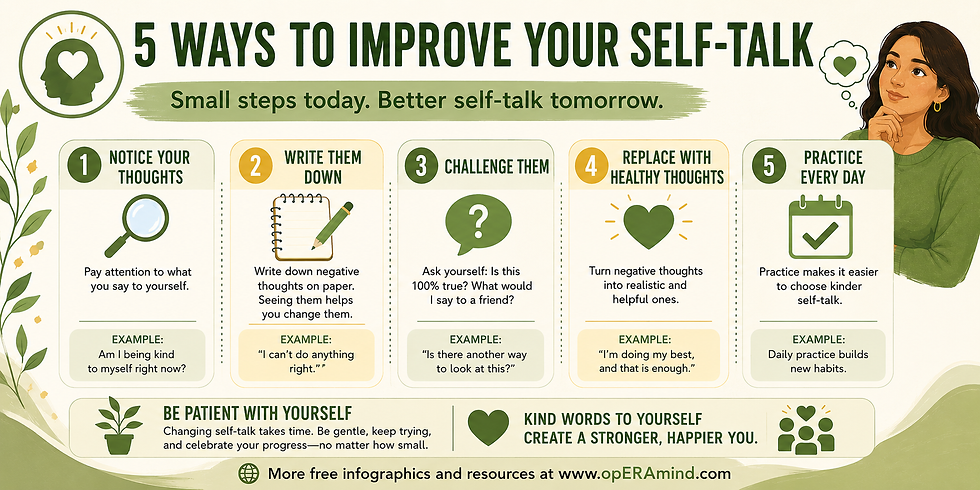
Changing the Conversation
Changing self-talk does not mean pretending everything is perfect.
It means learning to be honest without being cruel.
Instead of saying:
"I'm a failure."
Try:
"I'm still learning."
Instead of:
"I always mess everything up."
Try:
"That didn't go the way I hoped. What can I learn?"
Instead of:
"I give up."
Try:
"I'll try again tomorrow."
Small changes in our words can lead to big changes in how we feel.
Speak to Yourself Like Someone You Love
Think about how you would speak to your best friend.
Or a child.
Or even a puppy sitting in your lap.
Your voice would probably be gentle.
Patient.
Encouraging.
You deserve that same kindness.
Self-compassion is not making excuses.
It is creating a safe place inside your own mind.

There Is Hope
Our inner voice can change.
The brain learns through practice.
Every time we choose a kinder, more balanced thought, we are teaching our brain a new pattern.
Little by little...
The critical voice becomes quieter.
The compassionate voice becomes stronger.
Growth happens one conversation at a time.
Every Mind Has a Voice
Some people grow up hearing encouragement.
Others grow up hearing criticism.
Over time, those voices can become our own.
But our story does not have to end there.
The way we speak to ourselves can change.
Every kind word we practice is like planting a new seed.
With time, patience, and practice, those seeds can grow into confidence, hope, and resilience.
There is hope.

Free Opera Mind PDF, Infographic about Self Talk
OperaMind AI Refined — A carefully restored edition that preserves the original educational concepts while enhancing readability, accessibility, and visual design with thoughtful AI assistance.

Opera Mind Classic — The original human-made, hand-crafted version, created before the use of generative AI.


About This Resource
This Opera Mind resource was developed from Cognitive Behavioral Therapy (CBT) principles, clinical experience, professional training, and observations about the ways people speak to themselves. It encourages people to notice harsh or unhelpful self-talk and practice more balanced, realistic, and compassionate ways of responding to themselves.
Supporting References
Beck Institute for Cognitive Behavior Therapy. Understanding Cognitive Behavior Therapy (CBT).
Neff, K. D. (2023). Self-Compassion: Theory, Method, Research, and Intervention. Annual Review of Psychology, 74, 193–218. Research supports self-kindness and reduced self-judgment as important aspects of self-compassion.
PubMed — Self-Compassion Review
Developed by: Marisol Ada, LCSW / Opera Mind
Last reviewed: August 2026
Copyright & Use Policy
All content on this website — including but not limited to infographics, action plans, written materials, and downloadable resources — is the intellectual property of Opera Mind and is protected under U.S. and international copyright laws.
You may not copy, reproduce, modify, upload, publish, transmit, or distribute any material from this site without explicit written permission from the author.
Sharing of content for educational or non-commercial purposes is allowed only if:
Full credit is given to Opera Mind
The content is not modified, and
A direct link to the original website is included.
Unauthorized use, reproduction, or distribution of any material from this website may result in legal action.

Comments