
Updated: Aug 16

A simple way to understand why anxiety feels so overwhelming—and how your body can learn to feel safe again.
Reading time: 5 minutes
Best for: Self-help, patients, families, therapists, teachers, and caregivers
Includes: Printable infographic • Reflection questions • Practical tips

Imagine walking into your kitchen and hearing the smoke alarm.
Your heart jumps.
You look around.
There isn't a fire.
Someone simply burned the toast.
The alarm isn't broken.
It is doing exactly what it was designed to do.
It is trying to protect you.
Anxiety works much the same way.
It is your mind and body's alarm system.
Sometimes it warns us about real danger.
Sometimes it becomes so sensitive that it sounds even when we are safe.
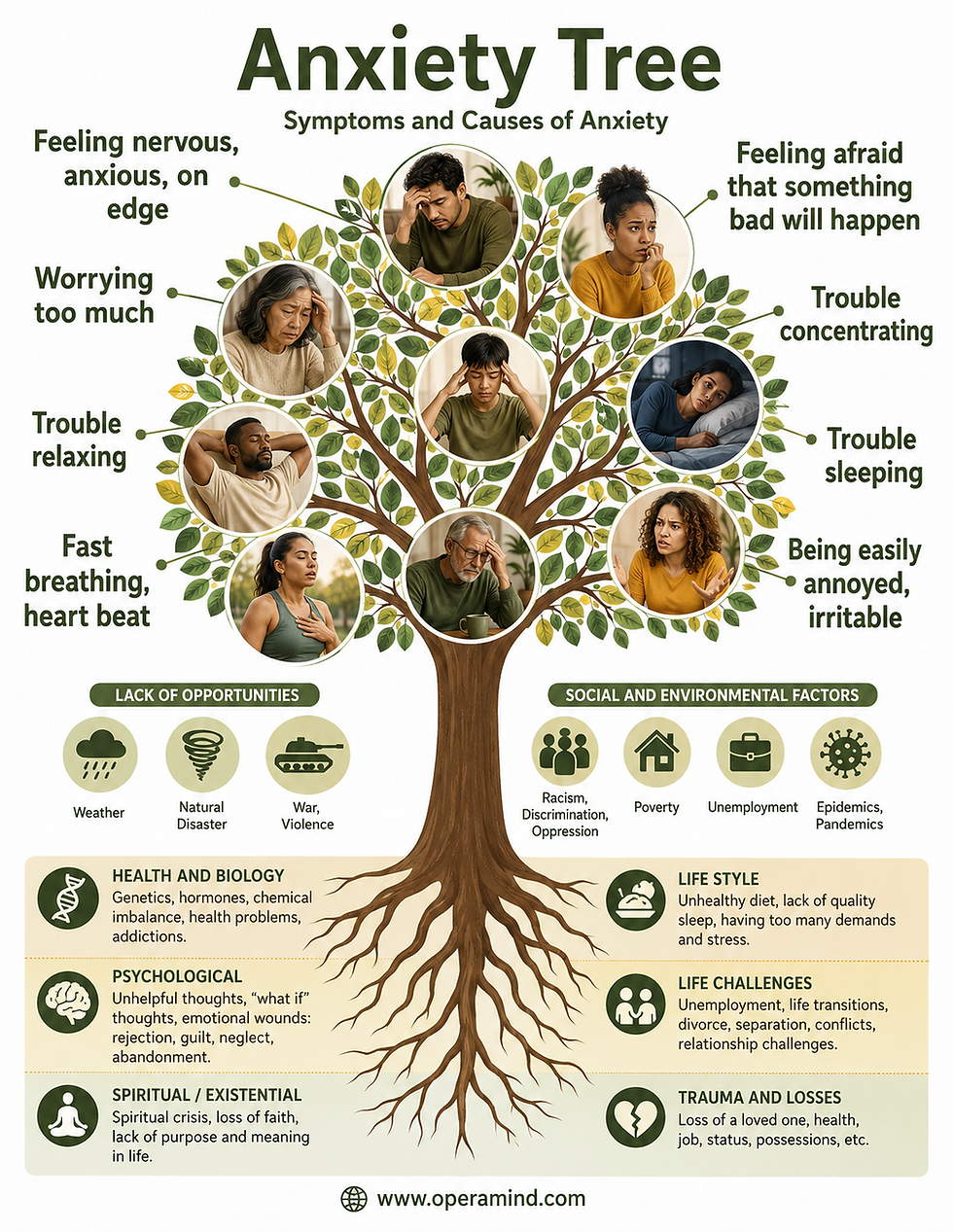
The Anxiety Tree is a simple way to understand why that happens.
It reminds us that anxiety is often more than worrying. Like a tree, it has branches we can see and roots we cannot always see.
Understanding both is often the first step toward feeling calmer.

The Branches: What We Can See
The branches are the symptoms of anxiety.
They may include:
Constant worrying
Feeling nervous or on edge
Trouble relaxing
Trouble sleeping
Trouble concentrating
Feeling restless
Muscle tension
Feeling irritable
Expecting something bad to happen
When anxiety becomes strong, even ordinary situations can feel dangerous.
A phone call.
Driving to work.
Walking into a meeting.
Waiting for medical results.
Your body reacts as though an emergency is happening, even when you know you are safe.
That can be exhausting.

The Roots: What We Cannot See
Just as a tree has roots hidden underground, anxiety often has causes that are not immediately visible.
Some roots are physical, such as:
Family history
Hormonal changes
Medical conditions
Chronic pain
Lack of sleep
A sensitive nervous system
Some roots grow from emotional experiences:
Rejection
Trauma
Loss
Bullying
Feeling criticized
Shame
Other roots come from everyday life:
Too many responsibilities
Work or school stress
Financial worries
Relationship challenges
Uncertainty about the future
Feeling alone
Feeling disconnected from your values, faith, or purpose
No two trees are exactly alike.
The roots of your anxiety may not be the same as someone else's.
It Is Not Your Fault
One of the most important lessons from the Anxiety Tree is this:
Anxiety is not weakness.
Anxiety is not overreacting.
Anxiety is not a character flaw.
Often, it is a nervous system trying very hard to keep you safe.
Sometimes it simply learned to stay on high alert because life has been stressful, painful, or unpredictable.
You deserve compassion—not criticism.

Healing Means Helping the Alarm Feel Safe Again
Imagine removing the batteries from a smoke alarm every time it makes noise.
The sound would stop.
But the real problem would remain.
Healing anxiety is not about ignoring the alarm.
It is about helping the alarm learn when it is safe to become quiet again.
Healing may include:
Counseling
Medication, when appropriate
Grounding skills
Deep breathing
Better sleep
Physical activity
Healthy daily routines
Supportive relationships
Setting healthy boundaries
Reconnecting with your values, faith, or purpose
Some tools help calm the alarm in the moment.
Others help change what keeps triggering it.
Both the branches and the roots deserve care.
There Is Hope
Our nervous systems can change.
People recover.
The alarm does not have to stay loud forever.
Healing often happens one small step at a time.
One slow breath.
One safe relationship.
One healthy habit.
One courageous conversation.
One moment of peace.
Small steps can help your body learn safety again.
Every Alarm Has a Story
Some alarms became louder after difficult experiences.
Some became sensitive after years of carrying heavy burdens.
Some learned to stay alert because they had to.
If your alarm feels loud today, remember this:
Your body is not working against you.
It has been trying to protect you.
With time, understanding, and support, the alarm can become quieter.
You can feel calm again.
There is hope.

Reflect on Your Own Tree
As you look at the tree, ask yourself:
Which branches describe how I have been feeling?
Which roots may be feeding my anxiety?
What situations make my alarm louder?
What helps me feel safe?
What is one small step I can take this week?
Who can support me as I heal?
There are no right or wrong answers.
The goal is to better understand yourself with kindness and compassion.
FREE ANXIETY TREE INFOGRAPHIC DOWNLOAD


OperaMind AI Refined — A carefully restored edition that preserves the original educational concepts while enhancing readability, accessibility, and visual design with thoughtful AI assistance.
Opera Mind Classic — The original human-made, hand-crafted version, created before the use of generative AI.

Sources & References
This resource is informed by established mental health research and educational guidance about anxiety, its symptoms, contributing factors, and treatment.
National Institute of Mental Health. Anxiety Disorders.
National Institute of Mental Health. Generalized Anxiety Disorder: What You Need to Know.
National Institute of Mental Health. I'm So Stressed Out! Fact Sheet.
Reviewed by: Marisol Ada, LCSW
Last reviewed: August 2026
Copyright & Use Policy
All content on this website — including but not limited to infographics, action plans, written materials, and downloadable resources — is the intellectual property of Opera Mind/ Marisol Vargas Vilugron and is protected under U.S. and international copyright laws.
You may not copy, reproduce, modify, upload, publish, transmit, or distribute any material from this site without explicit written permission from the author.
Sharing of content for educational or non-commercial purposes is allowed only if:
Full credit is given to Opera Mind
The content is not modified, and
A direct link to the original website is included.
Unauthorized use, reproduction, or distribution of any material from this website may result in legal action.


Comments