
Updated: Aug 13

Reading time: 5 minutes
Best for: Anyone who wants to better understand their thoughts and feelings.
Includes: Common thinking traps, everyday examples, reflection questions, and a printable visual guide.
Have you ever worn dirty glasses?
Imagine wearing glasses with a smudge on the lens.
The world hasn't changed.
But everything looks different.
Our thoughts can work the same way.
Sometimes our minds see a situation through a "thinking trap." When that happens, we may feel more worried, sad, angry, or discouraged than we need to.
The good news is that we can learn to notice these thinking traps and see things more clearly.
What Are Thinking Traps?
Thinking traps are automatic ways of thinking that are not always accurate.
They happen to everyone.
Sometimes they make a small problem feel much bigger.
For example:
"I made one mistake. I'm a failure."
"My friend didn't text back. They must be upset with me."
"Nothing ever works out."
These thoughts can feel true.
But feelings are not always facts.
Nine Common Thinking Traps
Our minds can fall into many different thinking traps.
Here are nine common ones.
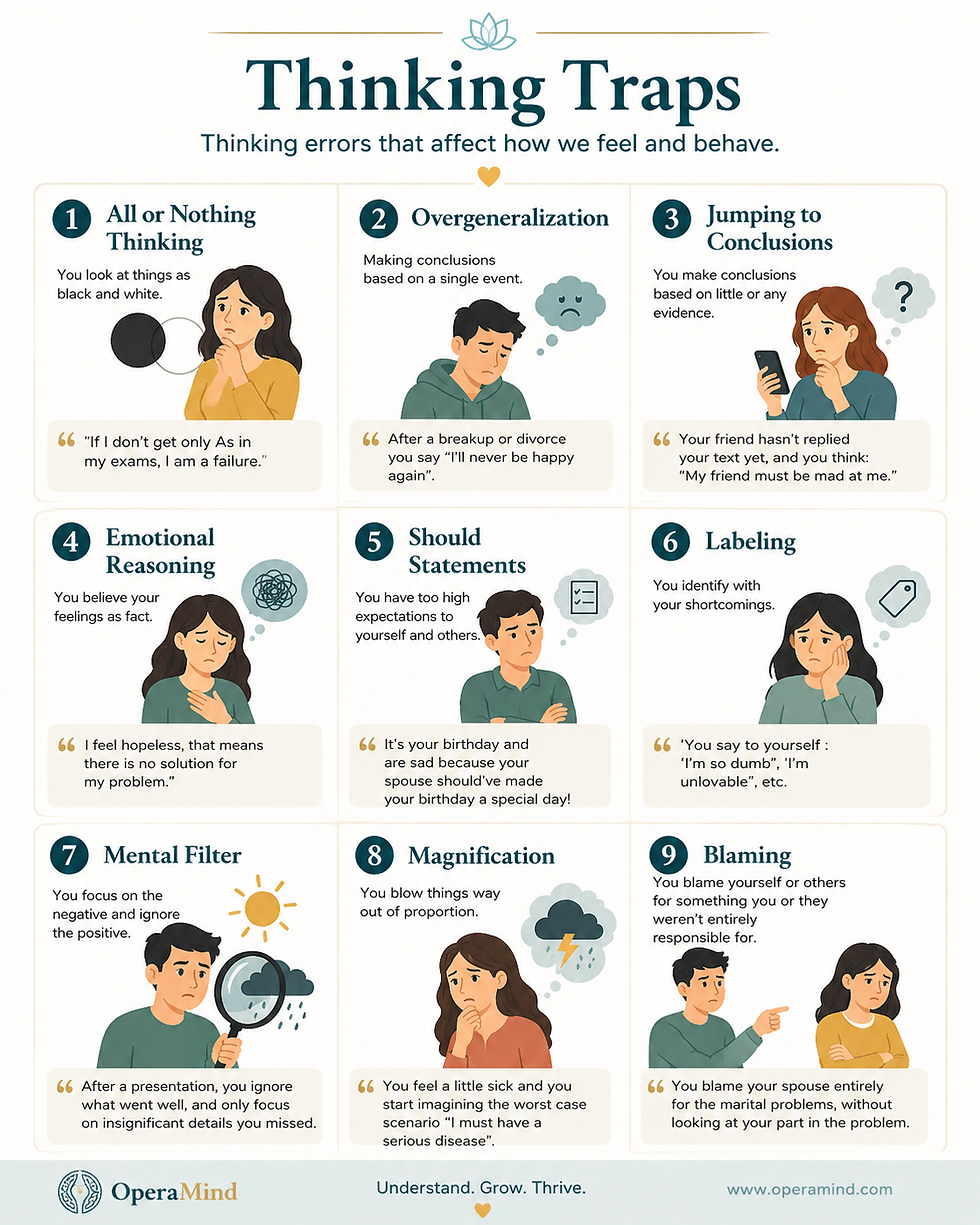
1. All-or-Nothing Thinking
Seeing things as all good or all bad, with nothing in between.
2. Overgeneralization
Believing one bad experience means the same thing will always happen.
3. Jumping to Conclusions
Making a guess without enough evidence.
4. Emotional Reasoning
Believing something is true because it feels true.
5. Should Statements
Using strict rules about how you or other people "should" act.
6. Labeling
Using one mistake to define yourself.
7. Mental Filter
Paying attention only to the negative while missing the positive.
8. Magnification
Making a problem seem bigger than it really is.
9. Blaming
Putting too much blame on yourself or someone else.
A Small Pause Can Change Everything
You do not have to believe every thought that comes into your mind.
The next time you notice a strong thought, pause and ask yourself:
Is this thought completely true?
What facts support this thought?
Is there another way to look at this?
What would I tell a friend in this situation?
Sometimes one new thought can change how you feel.
Everyday Example
Imagine you send a text to a friend.
Hours go by, and there is no reply.
One thought says:
"They must be mad at me."
A more balanced thought says:
"There could be many reasons they haven't answered yet. I'll wait before I make assumptions."
The situation stayed the same.
Only the thought changed.
Reflection Questions
Take a few minutes to think about your own thoughts.
Which thinking trap do I notice most often?
When does it usually happen?
What would a kinder, more balanced thought sound like?
How might that new thought change the way I feel?
Awareness is the first step toward change.
How to Use This Visual Guide
Keep this guide where you can see it.
You can use it:
During counseling.
While writing in a journal.
At school or work.
With family members.
Anytime you notice a strong emotion.
Start by looking for just one thinking trap.
Small changes can make a big difference over time.
Learn More:
Based on concepts from:
Burns, D. D. Feeling Good: The New Mood Therapy.
You may also enjoy:
Depression Tree
Anxiety Tree
Self-Compassion
Behavioral Activation
Burnout
Educational Disclaimer
This article is for educational purposes only. It is not a substitute for professional mental health care. If your thoughts or emotions are making daily life difficult, consider talking with a qualified mental health professional.

OperaMind AI Refined — A carefully restored edition that preserves the original educational concepts while enhancing readability, accessibility, and visual design with thoughtful AI assistance.

Opera Mind Classic — The original human-made, hand-crafted version, created before the use of generative AI.

Copyright & Use Policy
All content on this website — including but not limited to infographics, action plans, written materials, and downloadable resources — is the intellectual property of Opera Mind and is protected under U.S. and international copyright laws.
You may not copy, reproduce, modify, upload, publish, transmit, or distribute any material from this site without explicit written permission from the author.
Sharing of content for educational or non-commercial purposes is allowed only if:
Full credit is given to Opera Mind
The content is not modified, and
A direct link to the original website is included.
Unauthorized use, reproduction, or distribution of any material from this website may result in legal action.


Comments