
Updated: Aug 16

Reading time: 5 minutes
Best for: Self-help, patients, families, therapists, teachers, and caregivers
Includes: Printable infographic • Reflection questions • Practical tips
What if trauma is like a tree?

Imagine walking through a forest.
Some trees are tall and strong.
Others have broken branches or deep scars in their bark.
From the outside, every tree looks different.
But what we see above the ground is only part of the story.
The roots below the ground tell us much more.
People can be the same.
Trauma is not always visible.
Sometimes we see fear, anger, sadness, or trouble trusting others.
What we do not always see are the painful experiences that shaped those reactions.
The Trauma Tree is a simple way to understand that trauma has branches we can see and roots we cannot always see.
Understanding the whole tree helps us replace judgment with compassion—and begin to see where healing can start.

The Branches: What We Can See
The branches are the reactions people often notice after trauma.
They may include:
Trouble sleeping
Feeling jumpy or easily startled
Avoiding certain people or places
Difficulty trusting others
Strong emotional reactions
Feeling numb or disconnected
Feeling irritable or angry
Trouble concentrating
Feeling unsafe, even when you know you are safe
Sometimes these reactions surprise even the person experiencing them.
A loud noise may feel frightening.
A crowded room may feel overwhelming.
A simple disagreement may feel like danger.
These reactions are not signs of weakness.
They are signs that the nervous system has been trying to protect you.

The Roots: What We Cannot See
The roots are the experiences that continue to affect the mind and body.
Sometimes trauma comes from one overwhelming event, such as:
A serious accident
Physical or sexual assault
A natural disaster
Military combat
The sudden loss of someone you love
Sometimes trauma grows slowly over time through experiences such as:
Abuse
Neglect
Domestic violence
Bullying
Living with constant criticism
Growing up in an unpredictable home
Sometimes painful experiences are passed from one generation to another.
Families may unknowingly pass along fear, silence, or survival patterns.
Every person's tree is different.
The roots of your trauma may not be the same as someone else's.
It Is Not Your Fault
One of the most important lessons from the Trauma Tree is this:
Trauma is not weakness.
Trauma is not being dramatic.
Trauma is not a character flaw.
Trauma is often a brain and body doing exactly what it was designed to do—helping a person survive.
The survival responses that once protected you may now make everyday life more difficult.
You deserve compassion, not blame.
Healing Means Caring for the Whole Tree
Imagine caring only for the branches of a tree while ignoring its roots.
The tree may look better for a little while, but it will continue to struggle.
People are similar.
Healing is not only about reducing symptoms.
It is also about caring for the experiences underneath them.
Healing may include:
Trauma-informed therapy
Building safety
Grounding skills
Learning to calm the nervous system
Healthy relationships
Compassion and validation
Setting healthy boundaries
Reconnecting with your values, faith, or purpose
Some people begin by sleeping better.
Others begin by trusting one safe person.
Some begin by noticing feelings they have hidden for years.
Healing looks different for everyone.
There is no single path.
There Is Hope
The brain can change.
The nervous system can heal.
People recover.
Healing often happens one small step at a time.
One safe conversation.
One deep breath.
One healthy boundary.
One moment of courage.
One act of self-compassion.
Small steps can help the tree grow stronger again.
Every Tree Has a Story
Some trees carry scars from difficult seasons.
Some have broken branches.
Some have roots that had to grow through rocky ground.
Yet many of those same trees continue to grow.
They grow new branches.
New leaves appear.
They become strong again.
People can, too.
If your tree carries scars today, remember this:
Your scars tell the story of what you survived.
They do not decide who you will become.
Healing takes time.
Growth takes patience.
There is hope.
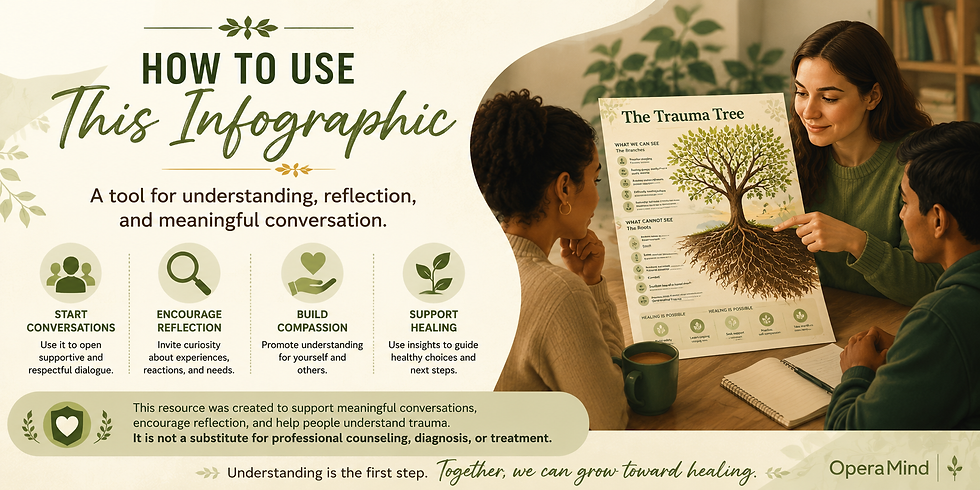
Reflect on Your Own Tree
As you look at the tree, ask yourself:
Which branches describe how I have been feeling?
Which roots may still be affecting me today?
What helps me feel safe?
What is one small step I can take this week?
Who helps me feel supported?
There are no right or wrong answers.
The goal is to better understand yourself with kindness and compassion.
Every tree has a story. Some trees have faced storms, droughts, or difficult seasons. Yet with time, care, and the right conditions, they continue to grow. People can, too. If your tree is struggling today, remember that healing takes time, but new growth is possible. There is hope.
FREE TRAUMA TREE INFOGRAPHIC DOWNLOAD


OperaMind AI Refined — A carefully restored edition that preserves the original educational concepts while enhancing readability, accessibility, and visual design with thoughtful AI assistance.
Opera Mind Classic — The original human-made, hand-crafted version, created before the use of generative AI.
Sources & References
This resource is informed by established research and clinical guidance about trauma, common reactions after traumatic experiences, and recovery.
U.S. Department of Veterans Affairs, National Center for PTSD. Common Reactions After Trauma.
U.S. Department of Veterans Affairs, National Center for PTSD. PTSD Treatment Basics.
U.S. Department of Veterans Affairs & U.S. Department of Defense. Clinical Practice Guideline for the Management of Posttraumatic Stress Disorder and Acute Stress Disorder (2023).
Reviewed by: Marisol Ada, LCSW
Last reviewed: August 2026
Copyright & Use Policy
All content on this website — including but not limited to infographics, action plans, written materials, and downloadable resources — is the intellectual property of Opera Mind and is protected under U.S. and international copyright laws.
You may not copy, reproduce, modify, upload, publish, transmit, or distribute any material from this site without explicit written permission from the author.
Sharing of content for educational or non-commercial purposes is allowed only if:
Full credit is given to Opera Mind
The content is not modified, and
A direct link to the original website is included.
Unauthorized use, reproduction, or distribution of any material from this website may result in legal action.


Comments